Machine Learning vs Artificial Intelligence: Key Differences
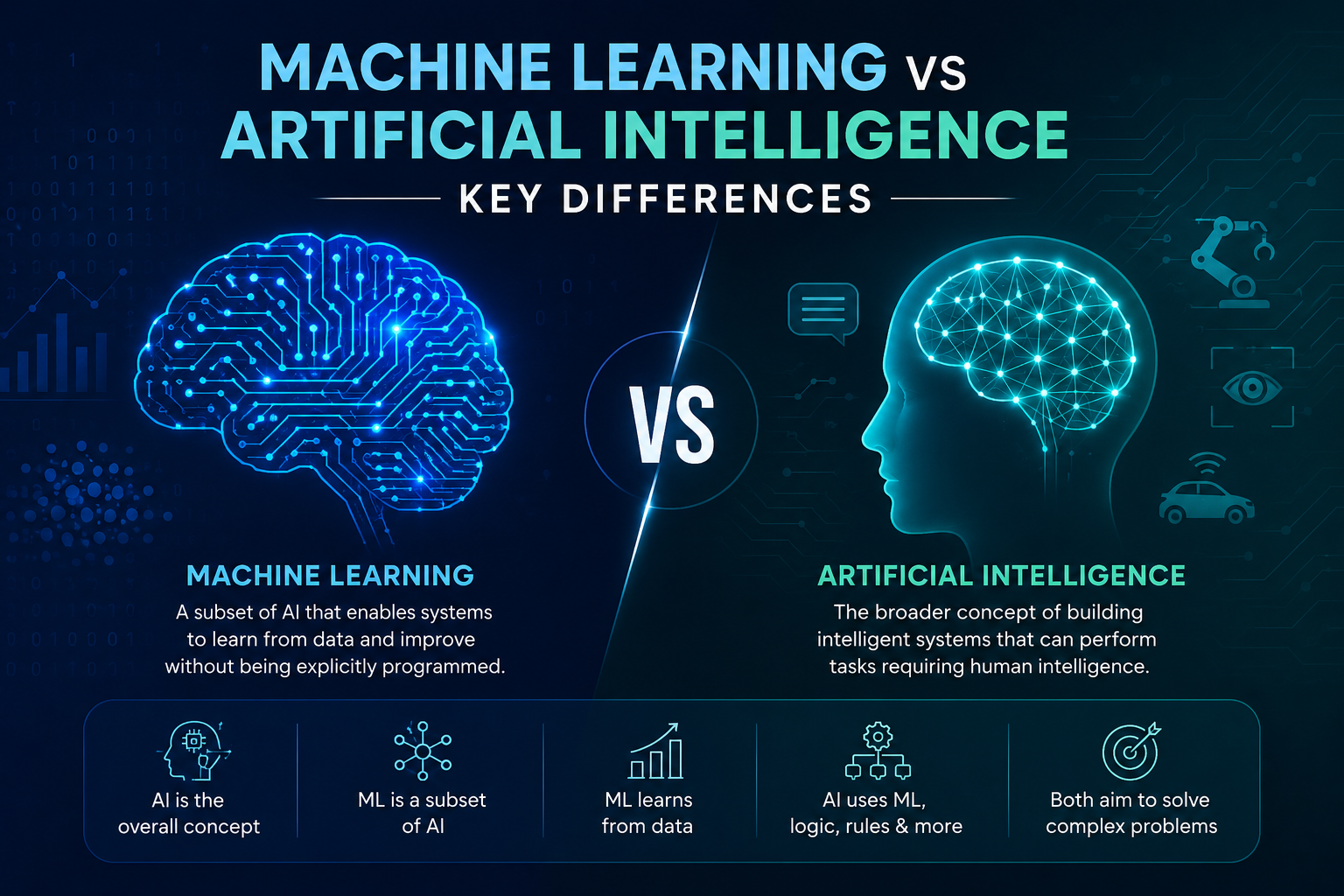
However, Artificial Intelligence (AI) and Machine Learning (ML) are among the most trans-formative technologies shaping today’s digital world. While these terms are often used interchangeably, they represent different concepts. Moreover, understanding the difference between AI and ML is essential for businesses looking to adopt intelligent technologies and stay competitive.
Firstly, this article explains what Artificial Intelligence and Machine Learning are, how they differ, and how they power innovations.
What Is Artificial Intelligence?
Specifically, Artificial Intelligence (AI) is a field of computer science focused on creating systems that perform tasks requiring human intelligence. For example, these tasks include reasoning, learning, problem-solving, understanding language, recognizing images, and making decisions.
AI, however, aims to develop machines capable of mimicking human thinking, enabling businesses to automate processes and improve decision-making.
Common Applications of AI
- Virtual assistants
- AI chat-bots
- Facial recognition
- Autonomous vehicles
- Fraud detection
- Smart recommendation systems
- Healthcare diagnostics
What Is Machine Learning?
Machine Learning (ML) is a subset of Artificial Intelligence that enables computers to learn from data without being explicitly programmed for every task.
Instead of following fixed rules, ML algorithms analyze historical data, identify patterns, and improve their performance over time. As a result, the more quality data they receive, the more accurate their predictions become.
Common Applications of Machine Learning
- Product recommendations
- Spam email detection
- Predictive analytics
- Demand forecasting
- Speech recognition
- Image classification
- Customer behavior analysis
Artificial Intelligence vs Machine Learning
Although closely related, AI and ML have different goals and capabilities.
| Artificial Intelligence | Machine Learning |
|---|---|
| A broad concept focused on creating intelligent systems | A subset of AI focused on learning from data |
| Can operate using rules, logic, or learning algorithms | Primarily relies on data and algorithms |
| Designed to mimic human intelligence | Designed to identify patterns and improve predictions |
| Covers reasoning, planning, perception, and decision-making | Focuses on model training and prediction |
| Includes Machine Learning, Deep Learning, and other technologies | Is one of several techniques within AI |
How AI and Machine Learning Work Together
Artificial Intelligence provides the overall framework for intelligent systems, while Machine Learning supplies the ability to learn and improve from experience.
For example:
- Additionally, an AI-powered customer support chat bot uses machine learning to understand customer questions and improve responses over time.
- A recommendation engine uses Machine Learning to analyze user preferences, while AI determines the most relevant suggestions to display.
Together, they create smarter and more adaptive business solutions.
Benefits of Artificial Intelligence
Businesses implementing AI can benefit from:
- Improved decision-making
- Increased operational efficiency
- Enhanced customer experiences
- Faster automation
- Better business insights
- Reduced operational costs
- Greater scalability
Benefits of Machine Learning
Machine Learning offers unique advantages such as:
- Accurate predictions
- Continuous improvement through learning
- Personalized customer experiences
- Real-time data analysis
- Better demand forecasting
- Fraud detection
- Predictive maintenance
Real-World Examples
Healthcare
AI assists doctors with diagnostics and treatment planning, while Machine Learning analyzes medical data to detect diseases and predict patient outcomes.
Finance
Financial institutions use AI to automate customer service and fraud prevention, while ML identifies suspicious transactions and predicts financial risks.
E-commerce
AI enhances the shopping experience through virtual assistants and intelligent search, while ML recommends products based on customer behavior and purchase history.
Manufacturing
Manufacturers use AI-powered automation to improve production efficiency, while ML predicts equipment failures before they occur, reducing downtime.
When Should Businesses Use AI or Machine Learning?
The choice depends on your business objectives.
Choose Artificial Intelligence when you want to:
- Automate customer interactions
- Build intelligent applications
- Improve decision-making
- Enhance business operations
- Create smart digital experiences
Choose Machine Learning when you need to:
- Predict future outcomes
- Analyze large datasets
- Detect patterns
- Personalize customer experiences
- Improve forecasting accuracy
In many cases, businesses achieve the best results by combining both technologies.
The Future of AI and Machine Learning
As technology continues to evolve, AI and Machine Learning will become even more integrated into everyday business operations. From intelligent automation and predictive analytics to generative AI and autonomous systems, these technologies are helping organizations innovate faster, improve efficiency, and deliver exceptional customer experiences.
Businesses that invest in AI and ML today will be better prepared for tomorrow’s digital economy.
How Talnovi Helps Businesses Leverage AI
At Talnovi, we develop intelligent digital solutions that help businesses harness the power of Artificial Intelligence and Machine Learning. From custom AI applications and predictive analytics to business automation and smart software development, our solutions are designed to improve efficiency, accelerate growth, and drive innovation.
Whether you’re starting your AI journey or expanding your digital capabilities, our team delivers salable, secure, and future-ready technology tailored to your business goals.
Conclusion
Artificial Intelligence and Machine Learning are closely connected but serve different purposes. AI is the broader concept of creating intelligent systems, while Machine Learning is the technology that enables those systems to learn from data and improve over time.
Understanding these differences helps businesses choose the right solutions for their needs. By embracing AI and Machine Learning, organizations can automate processes, uncover valuable insights, enhance customer experiences, and gain a lasting competitive advantage.
If you’re ready to explore AI-powered solutions, Talnovi is here to help you turn innovative ideas into real business results.

